
The solo travel myth?

In recent years there have been increasing reports of a dramatic growth in solo travel. The American Express 2024 Global Travel Trends Report identified solo travel as “a major trend among young travellers, with 76% of Millennials and Gen-Z planning solo trips this year.” The Forbes Travel Trends Report 2025 also reported an increase:
"Many more of us are jetting off on adventures alone. It could be a consequence of the pandemic, when many people became used to their own company through enforced isolation. Or perhaps it is a growing awareness of ‘self’ as a result of more conversations happening around mental health. Whatever the reason, many travel experts agree that solo travel is on the rise."

These ‘travel experts’ turn out to be companies such as ASA Luxury (a leading London-based travel communications agency) which identifies solo travel as a top emerging trend for 2025. The American Express 2024 Global Travel Trends Report says that: “solo travel is shown to be a major trend among young travelers, with 76% of Millennials and Gen-Z planning solo trips this year.” Women seem particularly interested in solo travel:
“A recent survey of Gen Z women found that more than half (58.3%) of respondents are interested in traveling abroad alone and an overwhelming majority (83%) stated they have been influenced by the travels of others, whether that be historical figures or social media influencers,”
Melissa Krueger, CEO of Classic Vacations, adds: “We believe that solo travel is a profound way to practice self-love and connection. While solo travelers are often on a deeply personal journey, they’re never truly alone, as they share a unique ecosystem with others pursuing similar experiences.
Oliver Winter of a&o Hostels also identifies a rise in the number of solo travellers in Europe. “This can in part be attributed to our post-pandemic desire to explore the world on our own terms.” Hilton Hotels also reports that Gen Z (55%) and Millennials (51%) are more likely to often travel on their own. Camp Social also reports that solo travel “has shifted from a niche pursuit to one of the fastest-growing segments in the global travel industry”, with “more people than ever … choosing to travel independently”. They also argue that solo female travel is “one of the fastest-growing travel segments”.
Seemingly impressive arguments – but do they have a basis in reality?
Travel statistics suggest not. Longitudinal studies of the global youth travel market by WYSE Travel Confederation show that fewer youth travellers went abroad solo in 2023 compared with the past 20 years. Those that do go solo are more likely to be men, and they report a higher impact in terms of awareness and changed behaviour. For the destination solo travellers are attractive because they tend to stay longer and spend more.
In the Netherlands, for example, the National Statistics Bureau reports that the proportion of holidaymakers travelling alone has actually fallen, reaching lower levels than those seen before the pandemic. The trends suggest that there may have been more solo ‘revenge travel’ immediately after the pandemic, but now more travellers seem to be seeking the company of others.
Dutch solo holidays have fallen below pre-covid levels

Data from the United States show a similar picture, with the proportion of travellers entering the country alone (59%) almost unchanged in recent years. The average party size has also varied little since 1997, with the exception of the Covid years.
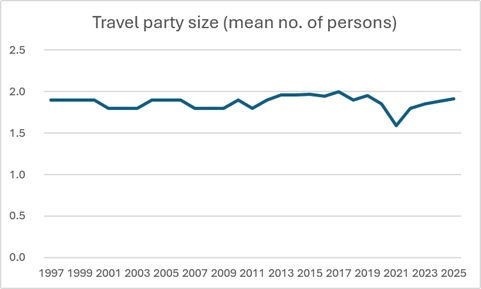
There is also no notable rise in searches for ‘solo travel’ on Google in the past year compared with other forms of travel, according to Statista.

If the Dutch National Tourist Board is to be believed, however, there may be an uptick in solo travel in the pipeline. Their Holiday Sentiment Monitor indicates that 14% of people in the UK and 16% in the USA are planning to travel solo in the coming year, in both cases 3% more than in 2025.
Hopefully, we will have some more empirical evidence to add to the mix soon. My colleagues Gijsbert Hoogendoorn and Anneli Douglas are currently looking at latent demand in the South African solo travel market, assessing those who have already travelled solo against those who haven't. Watch this space....


Comments