
The posters that invented Spain

Updated: Aug 28
Mid-summer in the northern hemisphere is traditionally a time for trivial news stories to entertain us as we take a bit of a break from the ‘real’ world – the so-called ‘silly season’. Because a lot of us are on holiday, much of the content also focusses on tourism. Journalists suddenly call tourism and leisure academics asking questions like ‘why do people go on holiday?’ or ‘what is the optimal amount of time to be on holiday?’ or ‘what is the size of the stag and hen party market?’
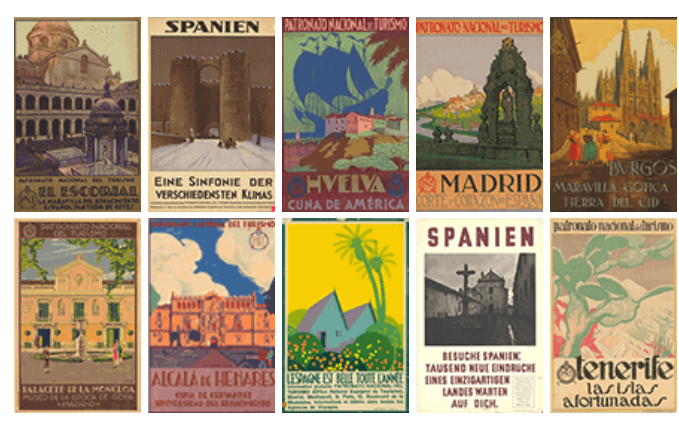
It is therefore a relief to have some serious tourism content released for the holiday/silly season. In this case, a study compiled by the Turespaña Tourism Documentation Center, based on the posters produced to promote Spain over the past 75 years or so. The volume The Image of Spain Through Its Tourist Posters, or as Gemma Larrègola in La Vanguardia much more poetically put it – ‘the posters that invented Spain’.

This volume of almost 600 pages covers the history of national tourism advertising for Spain since 1929, and covers key periods of the country’s tourism development up to the present. Jordi Hereu, the Minister of Tourism described the book as “a continuous visual narrative of the nation,” capable of reflecting different historical periods, as well as the perspectives of the artists who contributed to imagining the country. These included contributions from the work of Joan Miró and Salvador Dalí, as well as host of illustrators and designers who shaped the imaginary of Spain for hundreds of millions of tourists. A lot of this material can also be accessed through the online Museo Virtual de Arte Publicitario (MUVAP), which provides a historic overview of Spanish advertising.

The promotional history unfolded in the Turespaña book is fascinating in revealing the different phases of tourism promotion and the growing search for differentiation as other countries joined the mass tourism market from the 1960s on. Where the early tourism promotion in the 1930s and 1940s centred on the high culture offer of the monuments and museums of Spanish cities, the 1960s spawned the slogan ‘Spain is Different’, with the difference being highlighted through ‘typical’ Spanish culture (or at least the Francoist version of it) including "sun, beach, bullfighting, flamenco... and the body, especially the female body" as Larrègola remarks. The Spain is Different campaign lasted from the end of the 1950s to the beginning of the 1980s. As Spain advanced towards democracy during the 1980s the slogan became ‘Spain…Everything Under the Sun’, emphasising the diversity of the country, but also highlighting Miró’s emblematic Sun logo (“probably the most known tourism symbol in the world”) to encompass the rapid growth of leisure tourism.
Miró’s Sun was linked to a variety of tourism marketing efforts and it was echoed in the artists' contribution to the original Barcelona Airport terminal building, designed by the famous Catalan architect Ricardo Bofill. The ceramic mural, created in 1968, became a Bien de Interés Cultural, the highest level of heritage protection in Spain earlier this year. “The designation recognises not only its artistic significance but also its long-standing role as a symbolic gateway to the city for millions of travellers.” It also underlines the long-standing relationship between Barcelona, tourism and art, which made Catalan artists such as Miró and Dalí obvious ambassadors for the city.
In his thoughtful commentary on the book Ignacio Vasallo Tome reveals that Miró’s Sun was not so much a logo "but a collage that integrated the sun from an engraving exhibited in 1967 at the Maeght Gallery in Saint-Paul-de-Vence and the letters from the poster for the 1982 World Cup.” This collage was actually assembled by….., but Miró approved the proposal, donating the logo to Vasallo Tome for the State—"per al rei i el govern tot gratis” in the original Catalan, ironically (‘for the king and the government, all for free’).
Just like so many other destinations, Spain repositioned itself at the turn of the Millennium as an experiencescape. The advent of the experience economy was highlighted through English slogans including ‘Passion for life’, ‘Spain Marks’, ‘Smile. You are in Spain’ and ‘I need Spain’. Rather than specific experiences, Spain was positioned as a feeling, emotion or atmosphere produced by experiences of Spain.
The latest promotional turn is the campaign ‘Think You Know Spain? Think Again’, launched internationally in mid-2025. The campaign highlights different tourist profiles: families with children, solo travellers, and couples without children (empty nesters). This different locations across Spain, primarily inland or coastal destinations during the off-season. And of course it now has videos in vertical and horizontal formats, specially designed for digital media.

Interestingly, Turespaña itself has stuck with Miró’s Sun for its own logo, emphasizing the timeless simplicity of Miró’s work as well as the essential continuity of Spanish tourism marketing over the years. Although marketing objectives may change, many of the essential elements that the marketeers have to play with (and which appeal to many tourists) remain the same. As Gemma Larrègola remarks in her commentary for La Vanguardia:
Today we continue to travel within those images. Barcelona is recognizable before visiting it, the Costa Brava evokes a preconceived idea of the Mediterranean, Mallorca a promise of light, Gran Canaria an iconic landscape of dunes and ocean, and Andalusia an assumed cultural intensity. The traveler believes they are choosing, but in reality, they are interpreting.
This shift from choosing to interpreting will become even more marked with the rise of AI, where our ability to sift through the growing avalanche of information (and misinformation) will depend on our own wits and the efforts of a growing army of ‘travel curators’.
Reference:
Jorge Villaverde Izquierdo (2025) LA IMAGEN DE ESPAÑA A TRAVÉS DE SUS CARTELES TURÍSTICOS. MINISTERIO DE INDUSTRIA Y TURISMO, Madrid. https://cpage.mpr.gob.es/publicacion/la-imagen-de-espana-a-traves-de-sus-carteles-turisticos-2025-217250203-0000/
An overview of Spanish tourism publicity from 1929 to 2022 from the MUVAP


this article is very interesting and gave a very insightful look into how Spain markets itself as a tourist destination. one thing i noticed about these posters is that they are very artistic and abstract at times. this differs from what most tourist marketing campaigns look like which involve realism or direct photos of the location. while many of the posters involve real locations in Spain they are in an abstract style and many posters are entirely abstract and more often give off a certain vibe than show off an actual tangible place. i think that makes Spain stand out and how off its rich and artistic culture.
spain has been marketing tourism for almost a century now and have had so many different images and displays of art that are high key sales points for a trip. Explaining the need to want to travel and go to Spain and also bringing up the idea of more leisure tourism.